Is the LetBricks Neuschwanstein Castle 1:350 Worth Buying?
9.0/10. Worth buying. 13,028 pieces of Bavarian fantasy - King Ludwig's dream castle, brick by brick.
LetBricks didn't design this set for the casual castle buyer. At 13,028 pieces and a 1:350 scale, Neuschwanstein demands something most builders won't admit they're missing: patience measured in weeks, not hours, and a workspace that doesn't get repurposed for dinner. This isn't the Architecture line's crowd-pleasing geometry. This is a set that respects the actual complexity of Ludwig's creation, the asymmetrical towers, the authentic Romanesque Revival details, the spatial relationships that make the real castle a maze rather than a monument. Building it means confronting whether your parts organization system actually works or just theoretically works.
What matters before you commit: LetBricks sourced this through independent channels, which means availability isn't guaranteed, QC varies by batch, and you're buying from a MOC designer's production run, not a global supply chain. The instruction booklet is comprehensive but assumes you've built large architectural sets before. Halfway through, you'll understand why some builders skip anything over 5,000 pieces. The other half will realize they've been building the wrong sets all along.
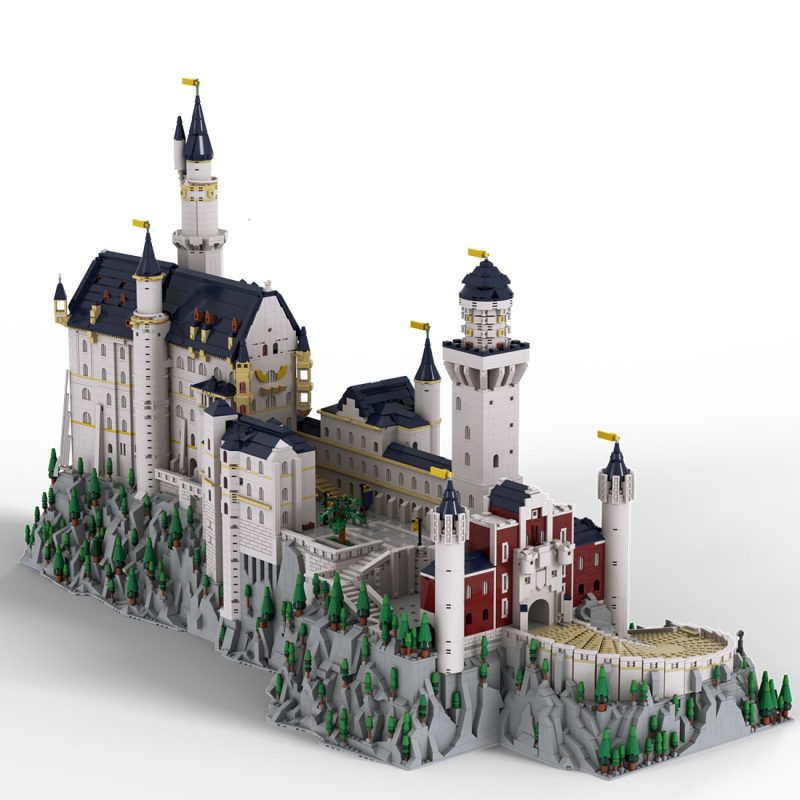
Building Neuschwanstein Castle from 13,028 pieces is an exercise in patience rewarded by spectacle. The construction begins with the rocky mountain base - an irregular, organic foundation built from dark grey and dark bluish grey elements that establishes the dramatic cliff-edge setting of the real castle. From there, the build transitions into the castle's lower courtyards and gatehouse before ascending through the main palace structure and its collection of towers, turrets, and connecting galleries.
What makes this build particularly engaging is the asymmetry. Unlike a skyscraper or a ship where you might repeat similar sections, Neuschwanstein's layout is inherently irregular - each wing meets the next at a different angle, each tower has a different height and profile, and the rooflines change constantly. Mocsage handles this by breaking the castle into distinct sub-assemblies that connect to the base at specific anchor points. The result is a build that rarely feels repetitive, even across the multiple sessions required to complete 13,000+ pieces. The final assembly of the tall cylindrical tower overlooking the gorge is a genuine moment of satisfaction.
The rocky mountain base phase is, unexpectedly, one of the most creatively rewarding parts of the entire build. Where the castle itself follows architectural logic - walls are straight, angles are intentional, rooflines follow geometric slopes - the mountain base is deliberately chaotic. You are building an organic rock formation, which means plates are offset at irregular intervals, rock panel pieces are angled at seemingly random orientations, and the overall form emerges through accumulation rather than precision. This phase teaches a completely different building discipline from the architectural work that follows: instead of following a blueprint, you are sculpting terrain, and the result needs to look unplanned and natural despite being fully designed. Builders who have only worked on structured, geometric builds will find this phase both challenging and liberating. The freedom to place elements in deliberately irregular patterns creates a sense of creative participation that more rigid construction sequences cannot match.
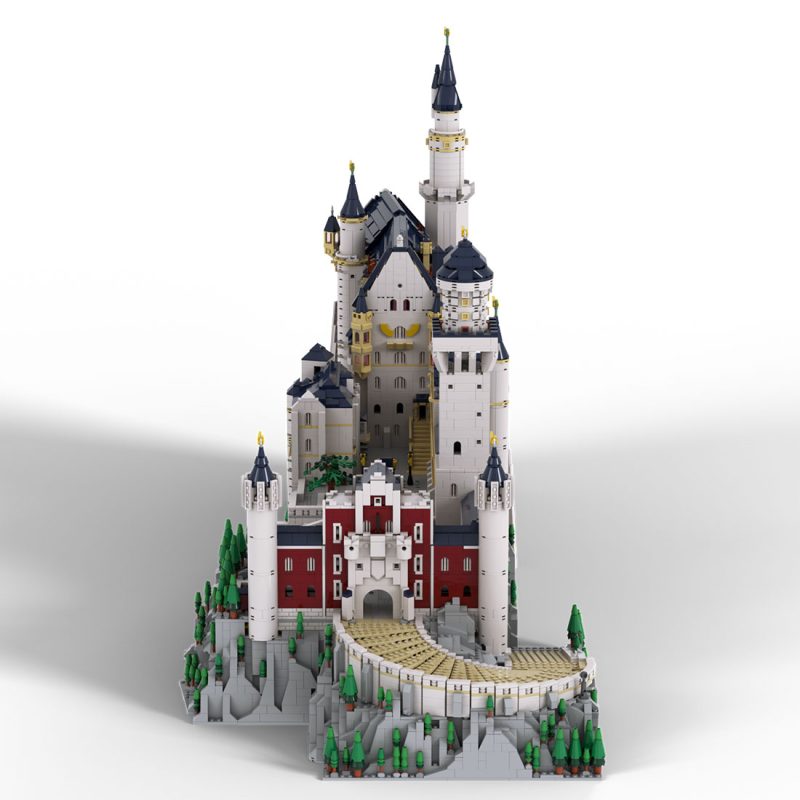
The architectural phases that follow the base construction reward a very different set of skills. Each wing of the castle is constructed as a separate sub-assembly with its own internal logic: the Gatehouse with its stepped gable and entrance archway, the Palas with its multi-story balcony loggia and ornate window rows, the Knights' Building with its simpler facade and connecting gallery, and the cylindrical tower with its blue conical roof. Building each sub-assembly independently allows you to focus on the specific architectural character of that section without the distraction of managing a single massive structure. When you finally connect the completed sub-assemblies to the base and to each other, the castle takes shape in a series of dramatic steps where each addition changes the skyline and adds a new visual element. That modular revelation - watching the castle assemble from its component buildings - mirrors the real castle's construction history, which unfolded over seventeen years as Ludwig added wings and towers to his evolving vision.
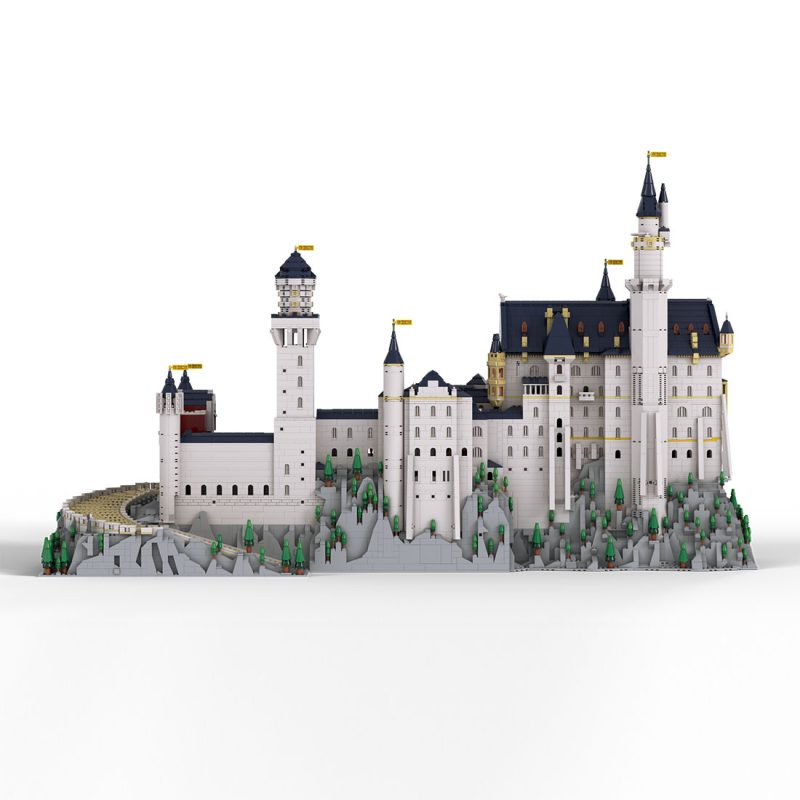
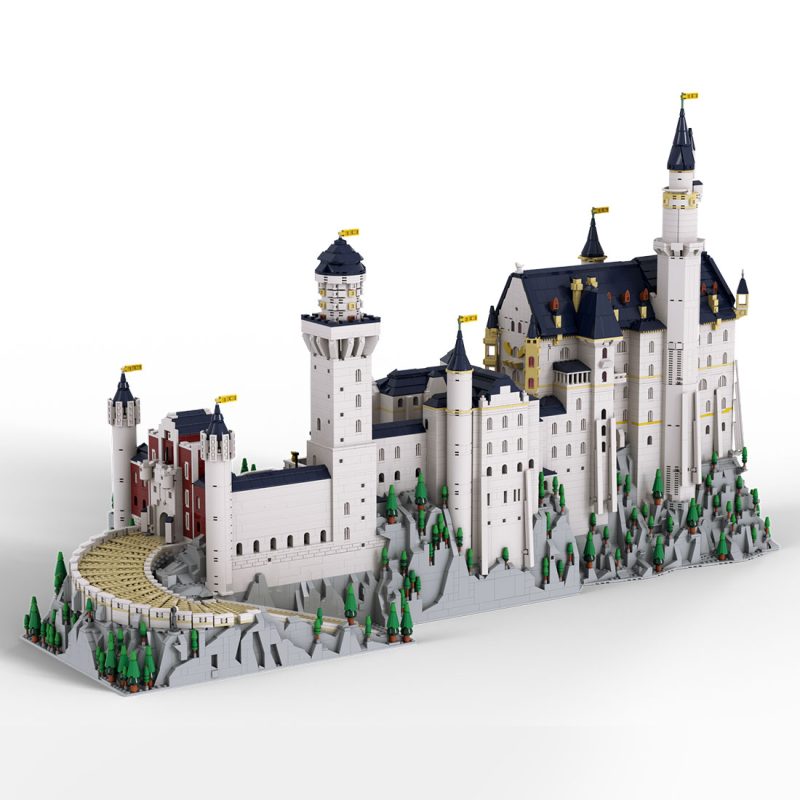
The 1:350 scale allows Mocsage to capture details that smaller castle models simply cannot. The real Neuschwanstein is a Romanesque Revival palace commissioned by King Ludwig II of Bavaria in 1869, and its defining features are all present here: the tall cylindrical tower with its conical blue roof, the Palas (the main residential building) with its ornate balcony loggia, the Singers' Hall on the fourth floor, the Gatehouse with its stepped gable, and the connecting gallery that bridges two sections of the castle across the courtyard.
The color palette is carefully chosen - light bluish grey and white for the limestone walls, dark blue for the slate roofs, and reddish-brown accents for the half-timbered elements visible on the inner courtyard facades. The blue conical roof on the main tower is achieved through a carefully angled cone of wedge plates that captures the steep pitch of the original. From multiple viewing angles, the model reads unmistakably as Neuschwanstein, which is the ultimate test of any architecture MOC. The stepped terrain with its rocky outcrops beneath the castle walls adds enormously to the sense of the building perched on its Bavarian ridge.
The architectural accuracy goes deeper than the major silhouette features and extends to proportional relationships that only become apparent through careful comparison with reference photographs. The ratio of the cylindrical tower's height to the Palas building's width is correct. The setback of the Knights' Building from the main facade line is proportionally accurate. The angle at which the courtyard gallery connects the two main wings matches the real building's geometry. These proportional accuracies are what give the model its immediate recognizability - the human eye is remarkably sensitive to architectural proportions, and even subtle errors in the relationship between major building elements can make a familiar building look "wrong" without the viewer being able to articulate why. Mocsage has clearly worked from detailed reference material and made the proportional relationships a priority, and the result is a model that passes the recognition test from every angle.
The blue conical tower roof is worth examining as a specific example of how design accuracy and engineering technique intersect at this scale. The real Neuschwanstein tower has a steeply pitched conical roof covered in dark slate tiles, and at 1:350 scale, this cone needs to taper smoothly from a wide base to a narrow peak over a substantial vertical distance. Mocsage achieves this with a spiral arrangement of wedge plates that step inward at each layer, creating a cone with remarkably smooth surfaces despite being built entirely from angular elements. The dark blue color is maintained consistently throughout the spiral, with no visible color variation or mismatched elements, and the peak terminates in a small gold-tone finial that catches the eye and provides a visual punctuation mark at the very top of the model's highest point. It is a technically demanding construction that produces a result of genuine beauty, and it is the feature that most photographs choose to highlight - which tells you everything about its visual impact.
The 13,028-piece inventory is dominated by light bluish grey elements in a wide variety of shapes - bricks, plates, tiles, slopes, and modified bricks that form the castle's limestone walls. This makes the set an exceptional parts source for anyone who builds castle or medieval architecture MOCs, as light grey is the foundation color for virtually any stone structure. The dark blue wedge plates and slopes used for the roofing are equally useful and less commonly available in bulk.
The rocky base sections contribute a large quantity of dark grey and dark bluish grey elements in irregular shapes, including rock panel pieces and modified plates that are specifically designed for terrain building. Clutch power is consistent throughout, and the structural connections between sub-assemblies are secure enough that the completed model can be carefully repositioned without fear of sections separating. At 13,000+ pieces, quality control matters enormously, and the build proceeds without problematic elements.
The light bluish grey element inventory alone makes this set a significant acquisition for any architectural MOC builder. Light bluish grey is the single most important color in castle and stone building construction, and it is consumed in massive quantities by any MOC that represents a limestone, concrete, or light stone structure. The Neuschwanstein set provides this color in virtually every element type: 1x1 through 2x8 bricks, 1x1 through 2x6 plates, tiles in every standard size, slopes at 25, 33, 45, and 65 degrees, curved slopes, inverted slopes, arch bricks, and modified bricks with studs on the side. This breadth of shape variety within a single color is extremely difficult to accumulate from standard retail LEGO sets, most of which include light bluish grey only in small quantities as secondary structural elements. A single purchase of the Neuschwanstein set provides an immediate, comprehensive light grey inventory that would otherwise require years of piecemeal accumulation.
The dark blue roof elements are the secondary inventory highlight. Dark blue slopes and wedge plates are used extensively in the castle's roof sections, and these elements are among the most difficult to source in bulk on the secondary market because they appear in relatively few LEGO sets at any price point. The Neuschwanstein provides them in dozens of sizes and profiles, creating a roof-building parts library that covers everything from large-area roof slopes to small trim elements. Combined with the light grey wall elements and the dark grey terrain pieces, the overall inventory constitutes a comprehensive architecture-specific parts collection that serves stone castles, modern buildings, and terrain work with equal depth. The reddish-brown accent elements for the half-timbered courtyard facades are a smaller but valuable bonus, adding warm-tone contrast elements that are useful for any period-appropriate architectural detail work.
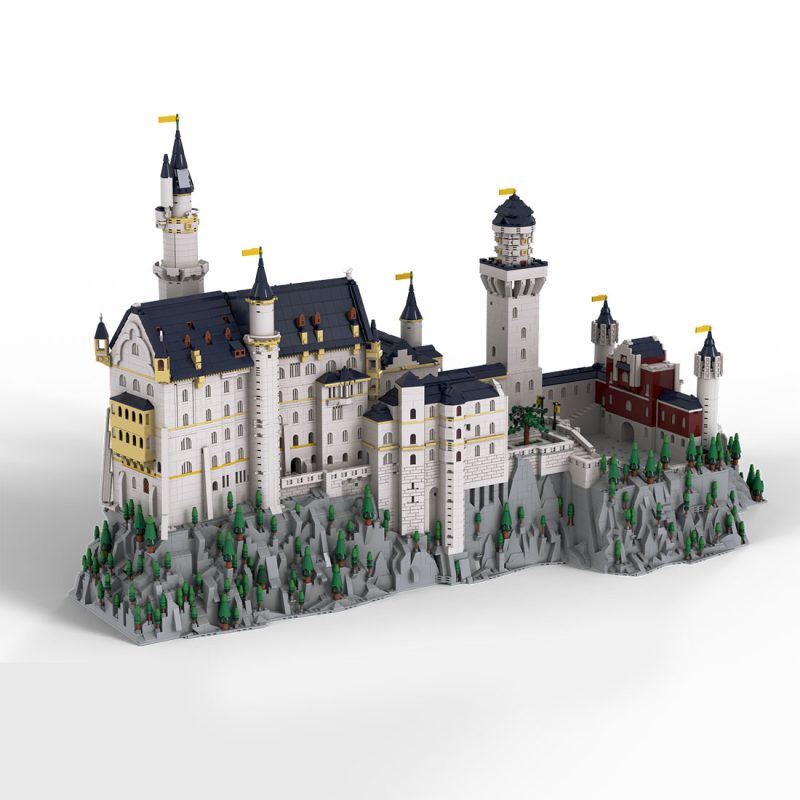
Neuschwanstein is arguably the most visually dramatic castle in the world, and at 1:350 scale with 13,028 pieces, this model captures that drama convincingly. The verticality of the towers, the cascading rooflines, and the rocky base that elevates the entire structure create a display piece with genuine three-dimensional presence - this is not a flat-backed model designed to sit against a wall. It rewards viewing from every angle, with each side revealing different architectural details and tower profiles.
The light grey-and-blue color scheme has a refined, almost ethereal quality on display that suits both modern and traditional interiors. Placed on a dark surface, the castle appears to float above its rocky pedestal in a way that recalls the real building's famous silhouette against the Alpine foothills. This is the kind of model that makes non-builders stop and examine it closely, which is the highest compliment any display piece can receive. It pairs beautifully with other European architecture sets if you are building a collection.
The three-dimensional display presence is this model's most compelling display characteristic, and it differentiates the Neuschwanstein from the vast majority of large-scale architecture MOCs that are designed primarily to be viewed from the front. The real castle is perched on a rocky spur with dramatic drops on three sides, and its towers and wings extend in multiple directions to take advantage of the ridge's irregular topography. Mocsage has faithfully replicated this three-dimensional layout, which means the model has no "back" - every side presents a different architectural composition with its own visual character. The north side shows the tall cylindrical tower rising above the rocky base. The east side reveals the Palas building's ornate loggia and the courtyard gallery. The south side presents the Gatehouse with its stepped gable. And the west side exposes the cliff face where the mountain drops away beneath the castle walls. This 360-degree display quality means the model can be positioned in the center of a table or on an open shelf where visitors can walk around it, discovering new details and new perspectives with each step.
Under different lighting conditions, the model takes on distinctly different characters that extend its display appeal. Under warm, diffuse daylight, the light grey walls and blue roofs take on a soft, watercolor quality that evokes the castle's fairy-tale reputation. Under directional spotlighting, the towers cast dramatic shadows across the courtyard and the rocky base, emphasizing the three-dimensional depth and creating a theatrical atmosphere. Under cool blue-white LED lighting, the model takes on a winter-morning quality that suits the castle's Alpine setting. Builders who invest in a small display spotlight or LED strip will find that the Neuschwanstein responds to directional light more dramatically than most models, because its irregular silhouette and varying surface angles create complex shadow patterns that change with the light source position. It is a model that rewards lighting experimentation, and the results are consistently impressive.
A 13,028-piece castle is a major investment, and the value equation depends on what you are looking for. As a display piece, this is one of the most impressive European castle models available in brick form at any scale. LEGO has never produced Neuschwanstein as a large-scale set (only as a micro-scale Architecture entry), making this the definitive brick-built version of one of the world's most visited landmarks. The piece-per-dollar ratio is competitive with other large-scale MOC sets, and the parts inventory in castle-friendly colors adds significant secondary value.
For architecture enthusiasts, castle collectors, or anyone with a connection to Bavaria and German culture, the uniqueness factor alone justifies the investment. This is not a set you will find duplicated on anyone else's shelf. The 1:350 scale strikes a good balance between detail and displayability, and the Mocsage design has been refined to a point where the engineering is sound and the finished model is stable. If medieval and classical architecture is your building niche, this belongs in your collection.
The comparison with LEGO's official Neuschwanstein Castle in the Architecture line is instructive and directly relevant to the value discussion. LEGO's micro-scale version captures the castle's silhouette in a compact display format at a fraction of the piece count and price. It is a good set that serves its purpose as a desk-sized architectural reference. The LetBricks 1:350 version is an entirely different proposition: it captures not just the silhouette but the substance of the castle, with individual windows, balconies, roof details, courtyard spaces, and terrain features that the micro-scale model cannot attempt. The two models are not in competition; they serve different audiences with different space allocations, different budgets, and different expectations for architectural detail. Builders who own the LEGO Architecture version and are considering the LetBricks upgrade should understand that the scale difference produces a qualitative, not merely quantitative, change in the model's impact. This is the difference between a photograph of a building and a architectural model of a building: one represents, the other recreates.
The Neuschwanstein Castle speaks to builders who approach the hobby as a form of architectural appreciation and who are willing to invest the time, space, and budget required by a project of this magnitude. Architecture enthusiasts will find a model that respects the source building's design with genuine fidelity, capturing not just the overall silhouette but the proportional relationships, material colors, and site context that define Neuschwanstein's identity. Castle collectors and medieval building enthusiasts will gain a centerpiece that anchors an entire European architecture display with the kind of presence that only a 13,000-piece model can command.
Travelers and cultural enthusiasts with a connection to Bavaria, Germany, or European history will find personal meaning in a model that recreates one of the continent's most visited and most photographed landmarks. Neuschwanstein receives over 1.4 million visitors annually, and for many of those visitors, the castle represents a defining travel memory. A brick-built recreation at this scale provides a tangible, permanent connection to that experience in a way that photographs and souvenirs cannot match. The build process itself becomes a form of extended engagement with the castle's architecture, deepening the builder's understanding of and connection to the original structure.
Experienced MOC builders looking for a long-term project that teaches advanced techniques across multiple building disciplines will find genuine value in the construction. The terrain sculpting of the mountain base, the architectural wall construction, the conical tower roof engineering, and the modular sub-assembly system each exercise different skills, making the build a comprehensive education in large-scale architectural MOC construction. Builders who complete this project will emerge with refined abilities in terrain work, proportional design, modular connection systems, and multi-session project management that serve any future large-scale build. The only audience this set does not serve is the casual builder looking for a quick weekend project - at 13,028 pieces, this is a commitment, and it demands the kind of sustained dedication that comes from genuine enthusiasm for the subject and the craft.
- ✓ 13,028 pieces capturing Neuschwanstein's full asymmetric layout
- ✓ 1:350 scale allows genuine architectural detailing
- ✓ Rocky mountain base adds dramatic three-dimensional presence
- ✓ All major features present: cylindrical tower, Palas, Gatehouse, galleries
- ✓ Massive parts haul in castle-friendly light grey and dark blue
- ✓ Rewards viewing from every angle - no flat back
- ✓ The only large-scale brick-built Neuschwanstein available
- ✗ Requires substantial display space due to irregular footprint
- ✗ Multi-day build commitment across many sessions
- ✗ No interior rooms or details at this scale
- ✗ Weight makes repositioning require careful handling
- LetBricks - The Alternative MOC Site - Everything about LetBricks
- LEGO Neuschwanstein Castle Review - The official Architecture version compared
- Flatiron Building Review - Another LetBricks architecture build
The turret repetition nearly broke me, then became the set's greatest strength. LetBricks engineered seven major towers that look distinct but share a core construction logic. After the third one, the system clicks. Your hands memorize the spiral pattern. Speed increases. What feels like a production nightmare the first time becomes meditative by tower five. Most architects avoid this kind of mechanical honesty; LetBricks leans into it. By the final turret, you're not following instructions anymore, you're completing a pattern you've internalized.
The secondary structure work, those bridges, buttresses, and connecting walls, matters more than the signature towers. They're what separate this from a stack of pretty towers. The set uses approximately 40% of its pieces on elements most people photograph once and never mention again. These connective sections are where the castle's actual spatial logic lives, and they're tedious enough that rushed builders will cut corners. Don't. The difference between a display piece that reads as architecture and one that reads as towers is whether you treated those middle sections as serious construction.