Affiliate link — I may earn a commission at no extra cost to you. Some sets reviewed may be provided by the manufacturer.
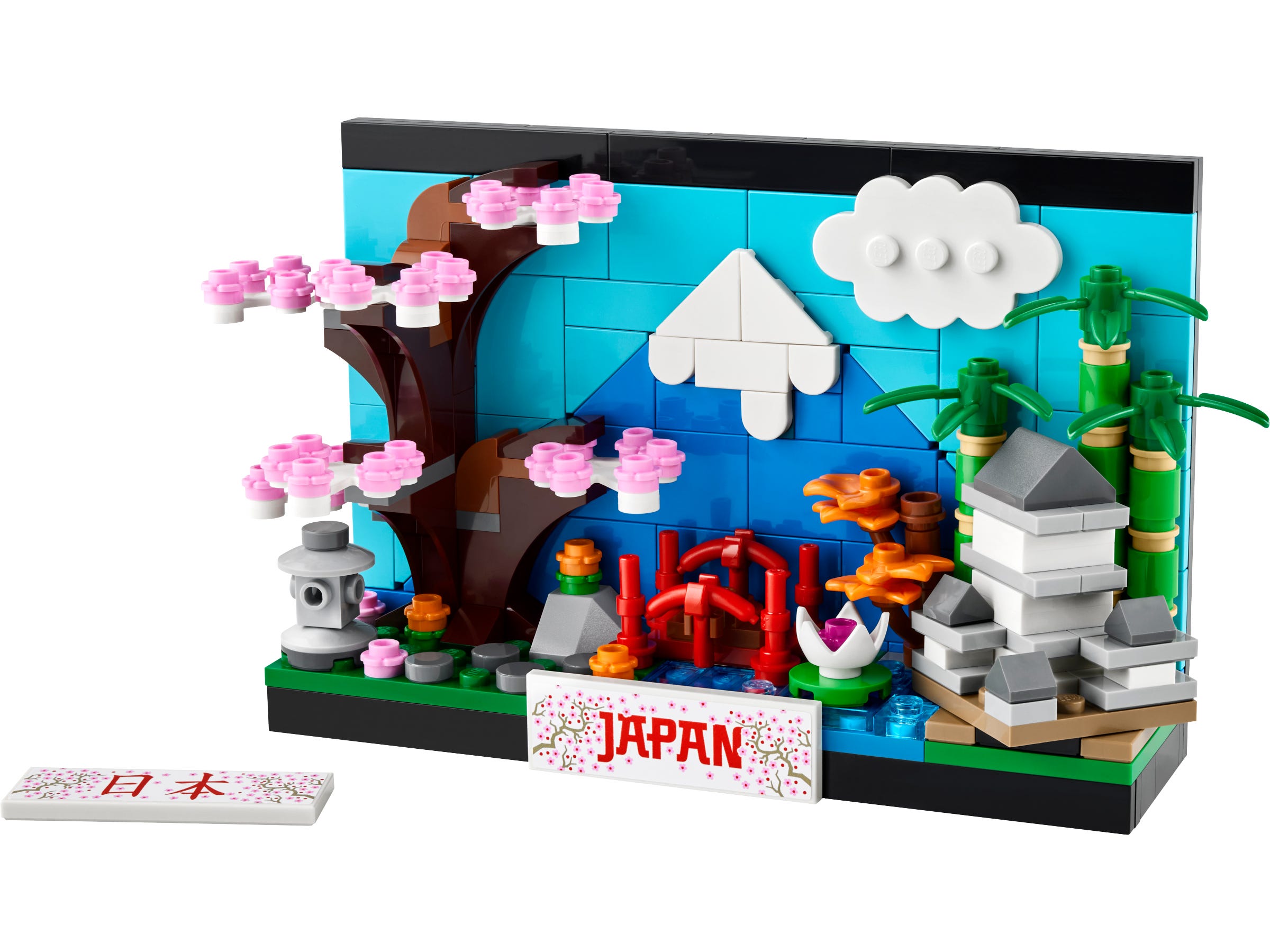
The Japan Postcard arrived in 2024 as the series hit its stride — and it shows. Designer Mel Caddick made the smartest compositional choice in any of the Postcards: instead of trying to represent a single city, Japan is treated as a cultural landscape. Mount Fuji dominates the backdrop, cherry blossom trees frame the midground, and a torii gate and traditional temple occupy the foreground. The result is far more coherent as a vignette than the city-skyline format.
262 pieces, about 25 minutes, with a distinctly different feel from the city postcards. The mountain construction is the highlight — white-peaked slopes stacked in a proper pyramidal layering that echoes the actual architecture of the Pyramid of Giza set in miniature. The cherry blossom trees use organic-form construction (round plates, stem elements, pink 1×1 round tiles) that reads as genuinely botanical. The torii gate is a simple but elegant subassembly.
The cherry blossom construction is the transferable technique here: 1×1 round pink plates clustered on flexible stems to create an organic bloom canopy — the same fundamental approach as the Botanical Collection trees, applied at micro-scale. This is a nice introduction to organic LEGO building for any newer builder. The mountain layering also demonstrates effective use of wedge slopes for large-scale profile construction.
262 pieces with an unusually rich color palette for the Postcard series: red, white, dark red, pink, dark green, and grey for the mountain. The pink 1×1 round plates (cherry blossom) are a handy micro-scale parts haul. The torii gate red elements translate directly into any Japanese-themed MOC work. This is the most parts-diverse of the four Postcards reviewed here.
The Japan Postcard is the most photogenic entry in the series. The red torii and pink blossom against the white Fuji peak creates a composition that reads as distinctly Japanese from any distance. It photographs better than it looks in the box — the spatial layering (gate foreground, blossoms midground, mountain background) creates actual depth. Displayed alone it holds its own; in a series lineup it steals attention.
262 pieces — same price, same value math. But the Japan Postcard delivers more compositional ambition per dollar than any of its series stablemates. It's the set to buy first if you're new to the series, and the one most likely to get non-LEGO people asking questions.
Affiliate link. Some products may be provided by the manufacturer. All opinions are my own.